Social media can help a hotel, accommodation, restaurant, or café increase brand awareness, generate demand, and attract more inquiries, reservations, or in-person visits.
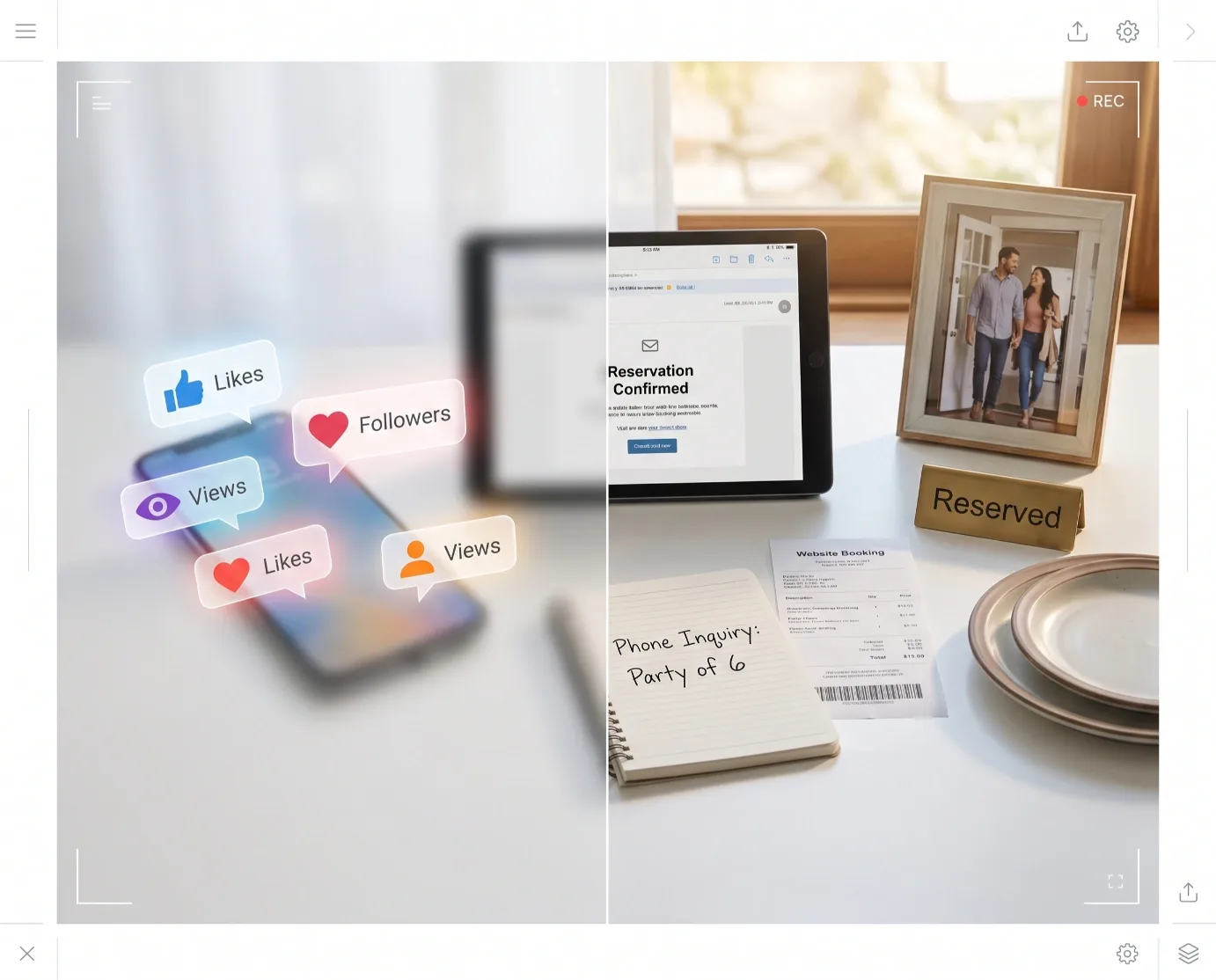
However, that doesn't mean every post that collects likes also delivers business results.
The real value of social media isn't measured only by followers, views, or reactions. It's measured by whether your content moves the right people closer to a meaningful business action: visiting your website, viewing your menu, checking availability, making a phone call, sending a message, booking a stay, reserving a table, or visiting your location.
The challenge is that this customer journey rarely happens inside a single app.
Someone may watch one of your Reels today, save your profile, search for your business on Google two days later, and call you a week afterward.
So the right question isn't:
"How many likes did we get?"
The right question is:
"How did social media contribute to the customer's attention, intent, and ultimately their decision?"
The Short Answer
To measure social media performance properly, you need four levels of measurement:
- Attention: How many relevant people saw your content?
- Interest: How many people saved it, shared it, visited your profile, or clicked a link?
- Action: How many people sent a message, called, requested directions, viewed the booking engine, or submitted a form?
- Business Outcome: How many reservations, visits, or sales resulted, and what was their value?
The biggest mistake many businesses make is stopping at the first level. They monitor reach and engagement but have no structured way of tracking what happens afterward.
Without that connection, you don't have meaningful social media reporting—you simply have activity reporting.
Why Likes and Followers Don't Prove ROI
Likes aren't useless. They indicate that a piece of content generated a reaction. Followers also matter because they create an audience that may repeatedly see your business over time.
The problem begins when these metrics are treated as the final business outcome.
A restaurant may have thousands of followers from countries that will never become customers. Likewise, a hotel may have a Reel with hundreds of thousands of views, yet most viewers may have no intention of traveling to that destination or may not fit the property's target audience.
On the other hand, a post with significantly lower reach may generate:
- more visits to the booking page,
- more availability inquiries,
- saves from people planning a trip,
- messages requesting a table reservation or special occasion booking,
- more branded searches on Google,
- genuine visits to the property.
The largest number isn't always the most valuable number.
The value of any metric depends on how closely it relates to a real business decision.
Before Measuring Metrics, Define What Social Media Should Achieve
You can't accurately measure something that doesn't have a clearly defined objective.
The same Instagram account shouldn't be evaluated the same way for every business or during every period.
A newly opened boutique hotel may first need brand awareness and strong storytelling around the guest experience.
An established hotel may instead need to increase demand during specific dates.
A restaurant in a tourist destination may want to fill slower weekdays.
A local café may care more about repeat local customers than gaining followers from across the country.
Your objectives may include one or more of the following:
- increasing awareness among a specific audience,
- generating more direct bookings,
- receiving more availability requests,
- increasing table reservations,
- attracting more in-person visitors,
- promoting a specific service or experience,
- improving low-season occupancy,
- encouraging repeat customers,
- generating more customer-created content,
- strengthening reputation and trust.
If your objective isn't clearly defined, your reporting will inevitably become a collection of disconnected numbers.
The Four Measurement Levels You Should Track
1. Attention: Did Your Content Reach the Right Audience?
At this stage, you'll typically evaluate metrics such as:
- reach,
- views,
- impressions,
- video watch time,
- video completion rate,
- new followers,
- audience demographics and geographic information where available.
These metrics are useful for identifying which topics and content formats attract attention.
However, they do not prove sales on their own.
The key question is:
Did the content reach people who are genuinely likely to visit, travel, or become customers?
2. Interest: Did the User Show Buying Intent?
Some of the strongest indicators of interest include:
- saves,
- shares,
- profile visits,
- clicks to the website or booking page,
- menu views,
- Story replies,
- Highlight views,
- repeated engagement with your profile.
For hospitality businesses, a saved post can often be more valuable than a like.
People frequently save hotels, restaurants, and travel experiences because they intend to return later while planning their trip.
This isn't yet a reservation—but it is a much stronger signal of intent.
3. Action: Did the User Move from Social Media to Your Business?
At this stage, you're measuring actions such as:
- clicks to the booking engine,
- form submissions,
- phone number clicks,
- WhatsApp clicks,
- email clicks,
- Instagram or Facebook direct messages,
- requests for directions,
- views of room or service pages,
- booking process starts,
- promotional code usage.
Google Analytics 4 (GA4) can record many of these actions as events. For this to work effectively, your website shouldn't simply look attractive—it should provide clear calls to action, proper tracking, and a user journey that doesn't lose visitors before they convert.
4. Business Outcome: What Did the Business Actually Gain?
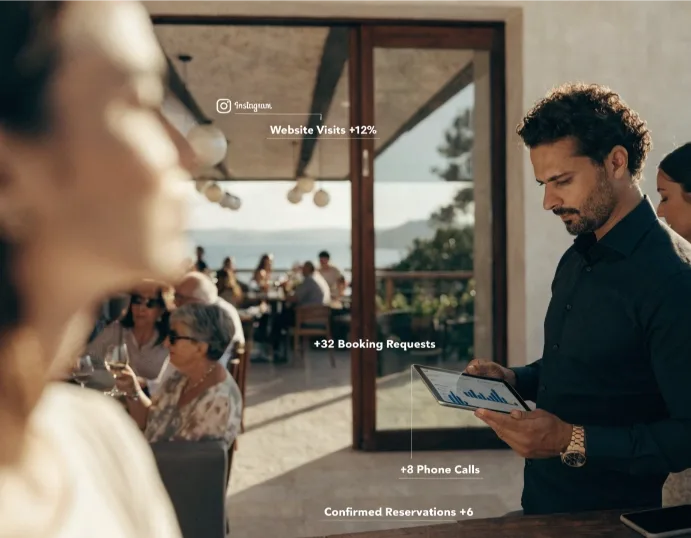
This is the most important—and often the most challenging—measurement level.
Here, you'll evaluate metrics such as:
- total reservations,
- revenue from direct bookings,
- restaurant reservations,
- qualified inquiries,
- cost per qualified lead,
- cost per booking,
- average booking value,
- bookings or sales generated through promotional codes,
- visits linked to a specific campaign,
- returning customers,
- the commercial quality and value of inquiries.
It's not enough to know that ten people sent you a message.
You also need to know:
- whether those inquiries were relevant,
- whether availability existed,
- whether they became paying customers,
- and what revenue they ultimately generated.
Which Metrics Matter Most for Hotels and Accommodation Providers?
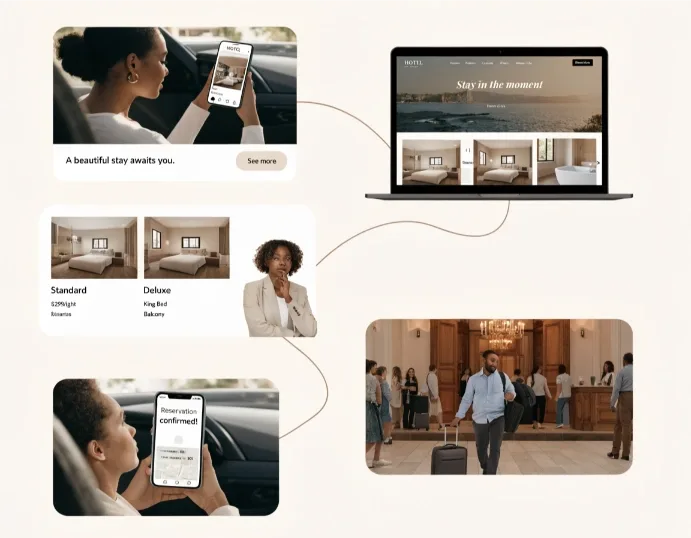
For hotels, villas, and smaller accommodation businesses, social media reporting should align with the travel decision journey.
The most valuable metrics typically include:
- website clicks,
- room page visits,
- booking engine clicks,
- booking process starts and completed bookings,
- availability requests,
- phone, WhatsApp, and email clicks,
- direct bookings generated or influenced by social media,
- booking value,
- stay dates and commercial quality of inquiries,
- branded Google searches following campaigns,
- saves and shares of destination or room-related content.
Hotels shouldn't evaluate social media solely based on whether "a post performed well."
Instead, they should ask whether their social presence reduced uncertainty for potential guests.
Prospective guests want to understand:
- where the property is located,
- what the rooms actually look like,
- the type of experience they'll have,
- which travelers the property is best suited for,
- how easy it is to reach,
- what's nearby,
- whether the online presentation reflects reality,
- and whether the business appears trustworthy.
Social media often acts as a trust-building stage before a booking is made.
This is one of the reasons why social media performance doesn't always appear as a simple "Instagram → Booking" conversion inside a report.
Which Metrics Matter Most for Restaurants and Cafés?
For restaurants, cafés, and bars, the customer journey is usually shorter and far more local.
Useful metrics include:
- map and direction clicks,
- phone number clicks,
- WhatsApp messages or reservation DMs,
- menu views,
- table reservation clicks,
- saves of food and location posts,
- Story replies,
- promotional code usage,
- tagged customer posts and user-generated content,
- reviews following a campaign or visit,
- increases in demand for a specific dish, event, or seasonal promotion.
Restaurants also face a significant measurement challenge:
Many customers discover the business through social media, remember the name, and simply walk in.
That visit will rarely appear automatically as a social media conversion.
For that reason, offline tracking mechanisms are equally important, including:
- asking customers, "How did you hear about us?",
- assigning unique promotional codes to campaigns,
- recording the traffic source in the reservation system,
- using QR codes or landing pages dedicated to specific campaigns,
- comparing customer traffic before and after promotions.
Self-reported attribution isn't perfect.
However, it's far better than having no attribution at all.
Building a Practical Measurement System

Step 1: Define One Primary Business Action
Don't try to measure everything from day one.
Instead, choose one primary conversion goal for each campaign or reporting period, such as:
- booking request,
- restaurant reservation,
- WhatsApp inquiry,
- booking engine visit,
- phone call,
- directions request,
- direct purchase.
If every action is treated as a conversion, then none of them receives proper priority.
Step 2: Use Consistent UTM Parameters
UTM parameters are added to URLs so Google Analytics can identify the source, medium, and campaign responsible for each visit.
A well-structured example might look like this:
``text utm_source=instagram utm_medium=organic_social utm_campaign=summer_direct_bookings utm_content=room_reel_01 ``
The goal isn't to create a complicated naming system.
The goal is consistency.
If one campaign uses instagram, another uses Instagram, and another uses ig, your reporting becomes fragmented and much harder to analyze.
Step 3: Track Meaningful Website Events
Your website should record the actions that actually matter to your business, including:
- booking button clicks,
- form submissions,
- phone clicks,
- WhatsApp clicks,
- email clicks,
- views of key service pages,
- booking or checkout starts,
- completed purchases where technically possible.
You don't need dozens of custom events.
You need a small number of clean, meaningful events that represent genuine business actions.
Step 4: Properly Configure Meta Measurement for Advertising Campaigns
For paid campaigns, the Meta Pixel and, where appropriate, the Conversions API (CAPI) can be used to record website events and improve ad measurement and optimization.
This doesn't mean Meta Ads Manager will capture every customer interaction perfectly.
It means your campaigns are built on a much stronger measurement foundation than simply boosting posts without proper tracking.
The best approach is to implement a structured Meta Ads strategy with clearly defined:
- campaign objectives,
- target audiences,
- creative assets,
- landing page experience,
- and measurement methodology.
Step 5: Record Messages, Phone Calls, and Offline Reservations
Many hospitality conversions happen outside your website, including:
- Instagram or Facebook DMs,
- WhatsApp conversations,
- phone calls,
- reception desk inquiries,
- in-person reservations,
- third-party booking platforms.
Create a simple tracking system such as:
| Field | Example |
|---|---|
| Date | 07/18/2026 |
| Source | |
| Campaign or Content | July Room Offer |
| Inquiry Type | Direct Booking |
| Estimated Value | $750 |
| Outcome | Confirmed |
| Notes | Saw a Reel and sent a WhatsApp message |
You don't need a sophisticated CRM from the beginning.
Even a consistent spreadsheet can reveal valuable patterns that aren't visible inside platform analytics.
Step 6: Analyze the Entire Customer Journey, Not Just the Last Click
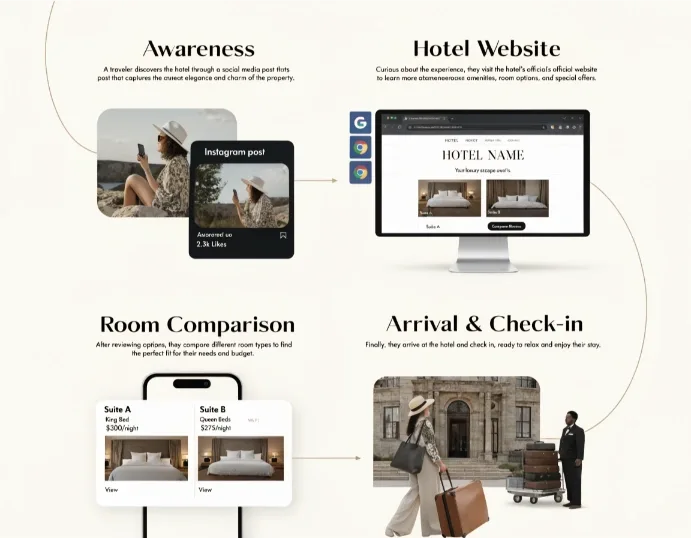
Customers often interact with multiple channels before making a decision.
For example:
- They watch a Reel.
- They visit your Instagram profile.
- They later return through a Google search.
- They read reviews.
- They complete a direct booking on your website.
If you only analyze the final click, you may incorrectly attribute the entire booking to Google and conclude that social media had no impact.
If you only look inside Ads Manager, you may overestimate Meta's contribution.
The most accurate interpretation comes from combining multiple data sources with real business context.
---
Organic Social Media and Paid Advertising Shouldn't Be Measured the Same Way
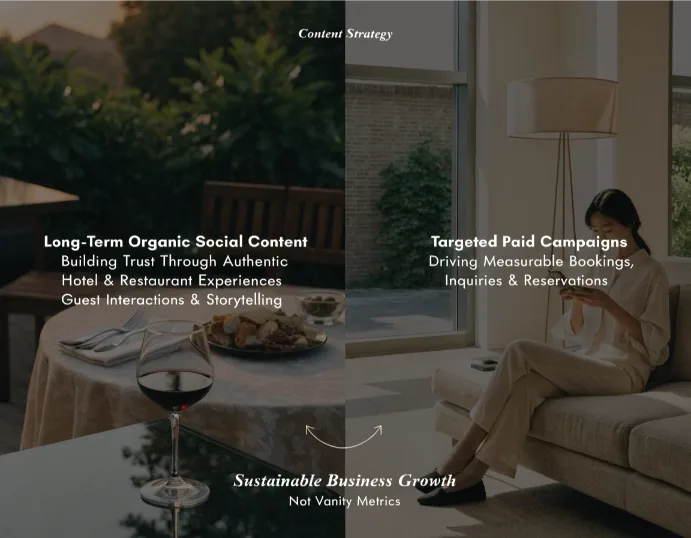
Organic content and paid advertising serve different purposes.
Organic Social Media
Organic content primarily helps:
- build long-term brand awareness,
- showcase the guest experience,
- establish trust,
- answer common customer questions,
- keep the business top of mind,
- influence future purchasing decisions.
Its impact is often gradual and indirect.
Paid Social Media
Paid campaigns can target specific audiences, geographic locations, time periods, and commercial objectives.
Their performance can be measured more rigorously using metrics such as:
- cost per landing page view,
- cost per lead,
- cost per message,
- cost per booking,
- conversion rate,
- revenue or booking value,
- lead quality,
- return on ad spend (ROAS), where reliable revenue data is available.
A common mistake is boosting whichever post receives the most likes without a clear business objective.
Your social media strategy should always align with:
- your website,
- your brand,
- current availability,
- promotional offers,
- and the operational realities of your business.
---
A Simple Monthly Social Media Dashboard for Hospitality Businesses
An effective monthly report doesn't need dozens of pages.
It simply needs to answer two questions:
- What happened?
- What should we improve next?
| Level | Metric | What It Shows |
|---|---|---|
| Attention | Reach among the target audience | Whether visibility increased |
| Content Performance | Saves, shares, watch time | Whether the content was valuable and engaging |
| Intent | Profile visits, website clicks | Whether users wanted to learn more |
| Action | Calls, DMs, forms, booking clicks | Whether users took meaningful action |
| Business Outcome | Bookings, visits, revenue | Whether commercial value was created |
| Cost | Cost per qualified inquiry | Whether the investment was efficient |
| Quality | Lead relevance and commercial value | Whether the right audience was reached |
| Learning | Best-performing topics, formats, and offers | What should be repeated or improved |
The most valuable part of any report isn't the dashboard itself.
It's the conclusions.
Every month you should be able to answer questions like:
- Which content generated the strongest buying intent?
- Which campaign produced meaningful business actions?
- Which offers attracted low-quality inquiries?
- Where are users dropping off?
- What should we stop doing?
- What deserves further testing?
- Which investments require improvements to the website, creative assets, or tracking setup?
---
The Most Common Social Media Measurement Mistakes
Measuring Only Followers
Follower growth doesn't necessarily mean customer growth.
Evaluate who your followers are, where they come from, and whether they take meaningful business actions.
Treating Every Message as a Qualified Lead
Not every message has commercial value.
An inquiry without genuine purchase intent, available budget, or compatibility with your services isn't equivalent to a qualified lead.
Ignoring UTM Parameters
Without consistent UTM tagging, much of your website traffic becomes difficult to attribute to specific campaigns or pieces of content.
Failing to Track Calls, WhatsApp Clicks, or Booking Buttons
For many local and hospitality businesses, these actions represent the most valuable website conversions.
Expecting Instagram to Measure the Entire Customer Journey
No platform can perfectly track every customer touchpoint—especially when decisions continue across devices, phone calls, or offline interactions.
Evaluating Performance Too Quickly
One week—or a single post—isn't enough to evaluate a strategy.
Reliable conclusions require:
- comparing reporting periods,
- repeated testing,
- and sufficient data volume.
Overlooking the Website and Booking Experience
If your content successfully creates interest but your website is slow, confusing, or difficult to use, social media alone cannot fix the customer journey.
In many cases, meaningful improvement begins with a stronger website and digital foundation—not simply publishing more content.
What Is Considered "Good" Social Media Performance?
There is no universal benchmark that defines good social media performance for every hotel or restaurant.
Strong performance depends on factors such as:
- profit margins,
- average booking or transaction value,
- seasonality,
- availability,
- market conditions and competition,
- target audience,
- advertising budget,
- content quality,
- website and booking experience,
- and the business's ability to respond quickly to inquiries.
For example:
- A hotel may consider a campaign highly successful if it generates only a handful of direct bookings with a high average booking value.
- A restaurant may prioritize a larger volume of customers with a lower average spend per guest.
- A café may focus more on customer retention and repeat local visits than on acquiring large numbers of new followers.
The most meaningful benchmark isn't your competitor's Instagram account.
It's your own historical performance, your commercial objectives, and the level of investment your business can realistically support.
---
Measurement Must Also Respect User Privacy
Your measurement strategy should never be separated from your data privacy obligations.
Analytics platforms and advertising technologies often rely on cookies and other tracking technologies.
Their implementation should include:
- an appropriate consent mechanism,
- clear user information,
- and technical implementation that respects user preferences.
Because of these privacy requirements, it's perfectly normal that you won't capture 100% of every customer journey.
Missing data shouldn't be replaced with assumptions.
Instead, it should be addressed by combining:
- platform insights,
- website analytics,
- tracked events,
- CRM data where available,
- manual attribution,
- and actual business outcomes.
This article does not constitute legal advice. Tracking implementations and consent mechanisms should always be reviewed according to your business, your technology stack, and the applicable legal framework.
---
Conclusion: Social Media Shouldn't Be Judged by the Amount of Noise It Creates
The purpose of a strong social media presence isn't simply to appear active.
Its role is to help potential customers:
- discover your business,
- understand the experience you offer,
- build trust,
- and confidently take the next step.
Measuring that contribution requires:
- clearly defined business objectives,
- the right metrics for every stage of the customer journey,
- properly implemented UTM parameters,
- meaningful website event tracking,
- accurate measurement for paid campaigns,
- recording phone calls and offline conversions,
- evaluating lead quality,
- and reviewing results every month to identify opportunities for improvement.
Likes can certainly be a positive signal.
They are not, however, a business strategy.
Real social media ROI comes from connecting your content, audience, website, tracking infrastructure, and commercial outcomes into one complete measurement system.
If your business consistently publishes content but struggles to generate actionable insights, the problem isn't necessarily that social media "doesn't work."
More often, the real issue is that the measurement system hasn't yet been built to reveal what works, for whom, and why.
---
Frequently Asked Questions About Social Media ROI
How is social media ROI calculated?
In its simplest form, ROI compares the net profit generated by social media activities against their total cost.
Costs should include advertising spend, content production, management time, and software or tools.
The real challenge lies in accurately attributing bookings or sales to social media efforts.
---
Are likes an important metric?
Yes—but only as an engagement metric.
Likes indicate interaction, but they don't prove business success.
Metrics such as saves, shares, profile visits, website clicks, inquiries, and confirmed bookings are usually much closer to actual commercial value.
---
Can Instagram generate direct hotel bookings?
Yes.
Instagram can drive booking engine clicks, direct messages, and reservations.
However, it often serves as an inspiration and trust-building platform before users eventually return via Google Search, the hotel website, or another channel to complete their booking.
---
How can I tell whether a booking came from social media?
Use a combination of:
- UTM parameters,
- website event tracking,
- booking engine analytics,
- promotional codes,
- and source attribution for phone or written inquiries.
No single system is perfect, but combining these methods provides a much clearer picture.
---
Which metrics should restaurants monitor?
Restaurants should pay close attention to:
- map and directions clicks,
- phone calls,
- WhatsApp clicks,
- menu views,
- table reservation clicks,
- direct messages,
- saves,
- tagged customer content,
- promotional code usage,
- and actual visits or reservations linked to campaigns.
---
Should I use the Meta Pixel and Conversions API?
They are valuable when running Meta Ads and wanting to track meaningful website events.
Whether they are appropriate depends on your website, booking system, consent implementation, and how reservations are completed.
---
How long does it take to see results from social media?
Paid campaigns often generate measurable data more quickly, provided there is enough volume and a properly structured campaign.
Organic social media usually produces results more gradually.
Performance should be evaluated over recurring reporting periods rather than based on a single post or a single week.
---
What should a monthly social media report include?
A useful monthly report should include:
- reach among the relevant audience,
- content performance,
- website traffic,
- inquiries,
- bookings or visits,
- campaign costs,
- lead quality,
- comparisons with previous reporting periods,
- and clear recommendations about what should continue, stop, or be tested next.
---